
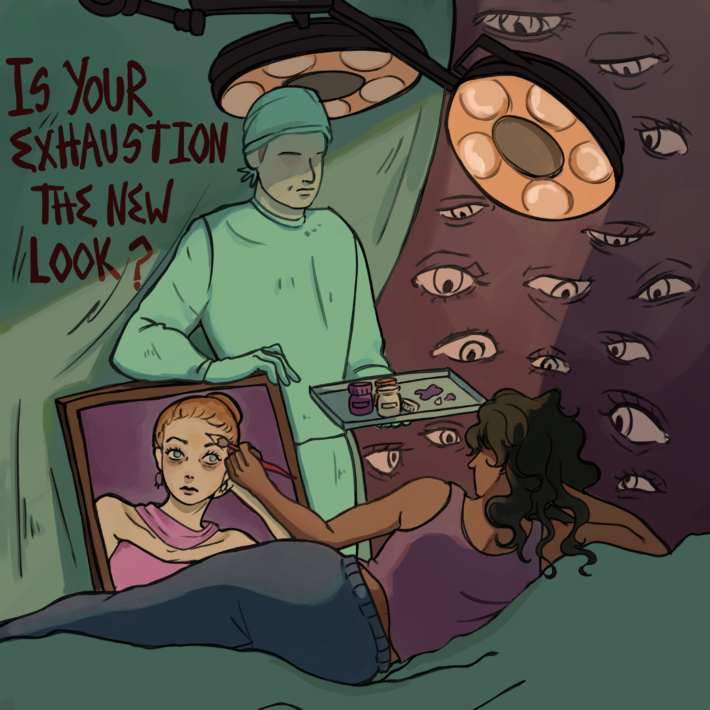
Written by – Shambhavi Tiwari, Batch of 2028
Caricature by – Gaurika Vashisht, Batch of 2029
I find myself frequently paralysed by how much cognitive space my appearance still occupies. I know, intellectually, that beauty is subjective, historically contingent, and politically weaponised. Yet, I still feel its weight every day like a physical pressure against my skin. Why does the pursuit of self-love feel so tangled and exhausting, even when I can see the gears of the machine that produces my insecurity? Why does my awareness fail to free me?
The answer is unsettling: awareness fails to free us because our system is not built on our ignorance, but on our participation.
This confusion is not a personal pathology but a structural byproduct. We live inside a society that presents constraint as self-expression, teaching us to experience regulation as choice. We are encouraged to curate ourselves within a narrow set of acceptable options, all while being told that this shaping is freedom. Discipline is reframed as empowerment, and conformity is sold as authenticity.
This system gleams with promises of confidence, desirability, and success, offering curated images and products that claim to guide us toward self-acceptance. Yet the freedom on display is carefully: we may choose, but only from what has already been approved. That is why the bars are polished so brightly that they look like mirrors. What limits us no longer appears as a force imposed from outside, but as something we willingly reflect on ourselves.
Which leads me to a question: Am I investing in myself or simply paying rent to exist?
Is self-deprecation becoming the new cool?
To understand this invisible voice, we must look to the panopticon: a prison designed with a central watchtower surrounded by circular rows of cells. From this tower, a guard can potentially observe every inmate, while the inmates cannot see the guard or know when they are being watched. Because visibility is one-sided, surveillance becomes constant in effect, even if it is intermittent in practice. The circular layout ensures that no one escapes the possibility of observation, making behaviour regulation a built-in feature of the space itself. Eventually, the guard is no longer necessary; the prisoner becomes their own jailer.
The philosopher Sandra Bartky suggests that modern femininity functions as a decentralised panopticon. No one explicitly forces a woman to suck in her stomach while sitting alone in her car, yet she does it. She anticipates the judgment of a gaze that isn’t even there.
I think of a friend who, even while hiking deep in the woods, alone except for trees and dirt, still checks her phone screen to make sure her hair hasn’t gone wild. I don’t say this to mock her. I recognise myself in it. This is what Bartky calls the “docile body”, one that evaluates and corrects itself automatically. The system is frighteningly efficient. It keeps our creative and political energy focused inward, on self-monitoring rather than collective questioning. When we internalise this hierarchy, we split into two: the person we are, and the ideal self who stands over us like a relentless foreman. The beauty industry plays into this split perfectly, flattering us with the promise of discovering our “glow,” only to reveal a new flaw the moment we think we’ve arrived.
Are your aesthetics moral enough?
People seem to have stopped believing in the concept of genetics, and there seems to be an increasing comfort in simply calling out people for not being obsessed with changing their appearances to abide by the laws of modernistic beauty. If we recall the past, then in the Victorian era, paleness was a sign of being high-class enough to avoid manual labour; smooth hands further meant you were loaded. The same concept can be used in our modern culture. A groomed, fit, and restrained appearance is read as proof of discipline, self-control, and responsibility. Conversely, to be unkempt or to occupy a body that defies the standard is framed as a moral failure, a lack of self-care or willpower. But wait, wasn’t the Victorian era 200 years ago? That would classify our obsession with aesthetics as quite medieval, not classy at all.
Our bodies and presentation are treated as evidence, and appearance becomes a form of testimony. We tell ourselves that if we can just look the part, people will believe we are competent, kind, and worthy of space. The irony is that the system encourages individuality while simultaneously dictating what individuality is allowed to look like.
Are the heavy words always meaningful?
I read somewhere that if we stripped away the “isms”, the heavy, academic labels like sexism, casteism, capitalism, or white supremacism, we might finally find a common language for our shared suffering. The argument is flawed, however, as there lies a danger in this linguistic softening. While removing these labels might lower the temperature of the room, it also risks obscuring the source of the heat. If we only talk about the symptoms — the exhaustion, the mirror-checking, the feeling of inadequacy, without naming the systems that profit from them, we run the risk of treating a broken leg with a cough drop. Without the heavy words, the struggle stays personal. If I don’t have the word “capitalism,” my inability to afford the ideal lifestyle looks like my own financial failure. If I don’t have the word “patriarchy,” my obsession with my wrinkles looks like my own vanity.
Without the language of capitalism and more specifically, class, it becomes impossible to explain why certain ways of looking, dressing, and existing are read as dignified while others are dismissed as vulgar or unrefined. The issue is not simply that some people cannot afford an idealised lifestyle; it is that markers of upper-class consumption are naturalised as indicators of taste, discipline, and worth.
This objectivity is often backed by pseudoscience. We see the revival of the Golden Ratio used to justify plastic surgery or social media filters. These tools claim to uncover a universal law of beauty, but they are almost always modelled on a narrow, Eurocentric archetype. By labelling these standards as math or nature, the system gaslights individuals like you and me. It suggests that if you feel ugly, you aren’t being oppressed by a standard; you are simply failing to meet a fact of the universe.
Eurocentric standards are especially powerful because they don’t announce themselves as ideals. They show up as defaults. Resemblance to the white, thin, able-bodied norm is rewarded; difference is treated as something to manage or tame. This “neutral” baseline doesn’t stop at workplaces or grooming policies; it is engineered into the technologies we use every day. Camera systems, from early film photography to modern digital imaging, were historically calibrated using lighter skin tones as the reference point. Exposure, lighting balance, and colour correction were designed to make white skin appear clear, detailed, and flattering, often at the expense of darker skin, which would be underexposed, flattened, or inaccurately rendered.
This is a visceral example of Colorism. In India, especially, the preference for lighter skin cannot be understood without confronting caste. Long before British rule, caste hierarchies had already linked fairness with purity, status, and proximity to power, while darker skin was associated with labour, pollution, and disposability. Colonialism did not invent this logic, but it reinforced and reorganised it, granting new economic and institutional advantages to those who already sat higher in the social order.
Today, the billion-dollar skin-lightening industry does not simply sell “glow” or confidence; it sells the illusion of caste mobility in a system designed to deny it. What is marketed as self-care is, in reality, an inheritance of caste discipline, repackaged for consumption. When a person reaches for a brightening cream, they aren’t just engaging in a “beauty routine”; they are navigating a historical trauma.
Money Money Money and Um Racism?
What counts as “better” is deliberately unstable. Ideals shift just as they begin to feel reachable, ensuring that no one ever arrives. The “heroin chic” of the 1990s—gauntness framed as elegance—gave way to the exaggerated curves of the BBL era, which in turn softened into the minimal polish of the “clean girl.” Each phase presents itself as corrective, as though it finally knows what beauty should look like, even as it quietly prepares to be replaced.
These trends are not neutral. The West routinely recycles aesthetics rooted in Black womanhood – full lips, sculpted bodies, slicked-back hair – while stripping them of context and consequence. The same features that once invited ridicule, harassment, or punishment are rebranded as aspirational once they are worn by whiter, thinner, wealthier bodies. What was stigmatised becomes fashionable, and what was survived becomes monetised.
A similar extraction operates within Indian aesthetics. Features long associated with certain regions, castes, or classes – brown skin, thick brows, body hair, traditional jewellery, indigenous fabrics – have historically been marked as excessive, backward, or unrefined. Yet these same aesthetics resurface cyclically, sanitised and selectively embraced. Kohl-lined eyes, oiled hair, bindis, nose rings, and “dusky” skin tones are celebrated once they are detached from the bodies that were shamed for them, reframed as trends, spirituality, or effortless elegance.
As with all aesthetic borrowing, the appeal lies not just in the culture itself, but in the ability to access it without inheriting its burdens.
Even features that were once mocked can be commodified, which takes up on an extremely disgusting issue in itself. “Fox eyes” or certain facial contours, for example, go from taboo to trending once detached from the cultures that originally embodied them. Were these not the same asians who were once treated less than animals? The boom of Korean skincare around the world, in itself, is disgusting to be referred to as a new necessity, considering once upon a time (just half a decade ago) that very glass skin people dream of was considered to be “a plain nothing”. Suddenly, what was once described as a slur became your new need.
Self-care is often the cleverest con of all. It promises empowerment while quietly shifting the labour and expense onto the individual. Love yourself! It says, but only after you’ve applied this 6000 Rs. serum, completed that 20-minute skin ritual, and attended to every wrinkle and contour like a forensic artist. Even the “no-makeup” look is a production: twenty minutes of gels, primers, highlighters, and concealers to achieve the illusion of effortlessness. Effortless is the new currency, and the price is maximum effort (and well actual currency).
The economics of beauty are brutal and funny if you step back for a second. How does one critique the standards and yet relish in their glory? Lip plumpers, skin supplements, lash extensions, face masks, workout subscriptions, diet apps – each promises autonomy, control, or liberation while quietly extracting time, money, and stability of mind.
The cruelty of a society benefitting from consumerism is most visceral when it asks you to give up your own sustenance. Diet culture is the predatory heartbeat of this system, a mechanism that teaches us to view the act of eating, the most fundamental requirement for staying alive, as a battlefield of moral failure. There is a specific, jagged hurt in realising that we have been trained to fear the very things that nourish us. I see it in the eyes of friends who scan a menu not for flavour, but for safety, calculating their sins in calories as if they are preparing for a trial. I find it deeply, fundamentally chilling that we live in a world where the sensation of a hollow stomach is celebrated as a victory. The reality is that we live in a society where quiet, gnawing starvation, both physical and emotional, exists. Diet culture doesn’t want you to be healthy; it wants you to be compliant. It wants you so preoccupied with the circumference of your thighs that you don’t have the energy to notice how much of your life is being stolen. Every moment spent counting almonds is a moment stolen from a fulfilled heart.
What is the point of discussing this?
Every end to a system comes from frustration. Your awareness and participation in a world such as this might just be fueling the dissatisfaction you have with your existence. A feeling so universal and yet frowned upon.
The question is not whether the system is unfair; we already know the answer to that. The question is what we are willing to do with that knowledge. If taking care of yourself consistently leaves you smaller, quieter, and more afraid, then something has gone wrong. And calling that harm “health” does not make it any less real.
I hope I was able to convey that.